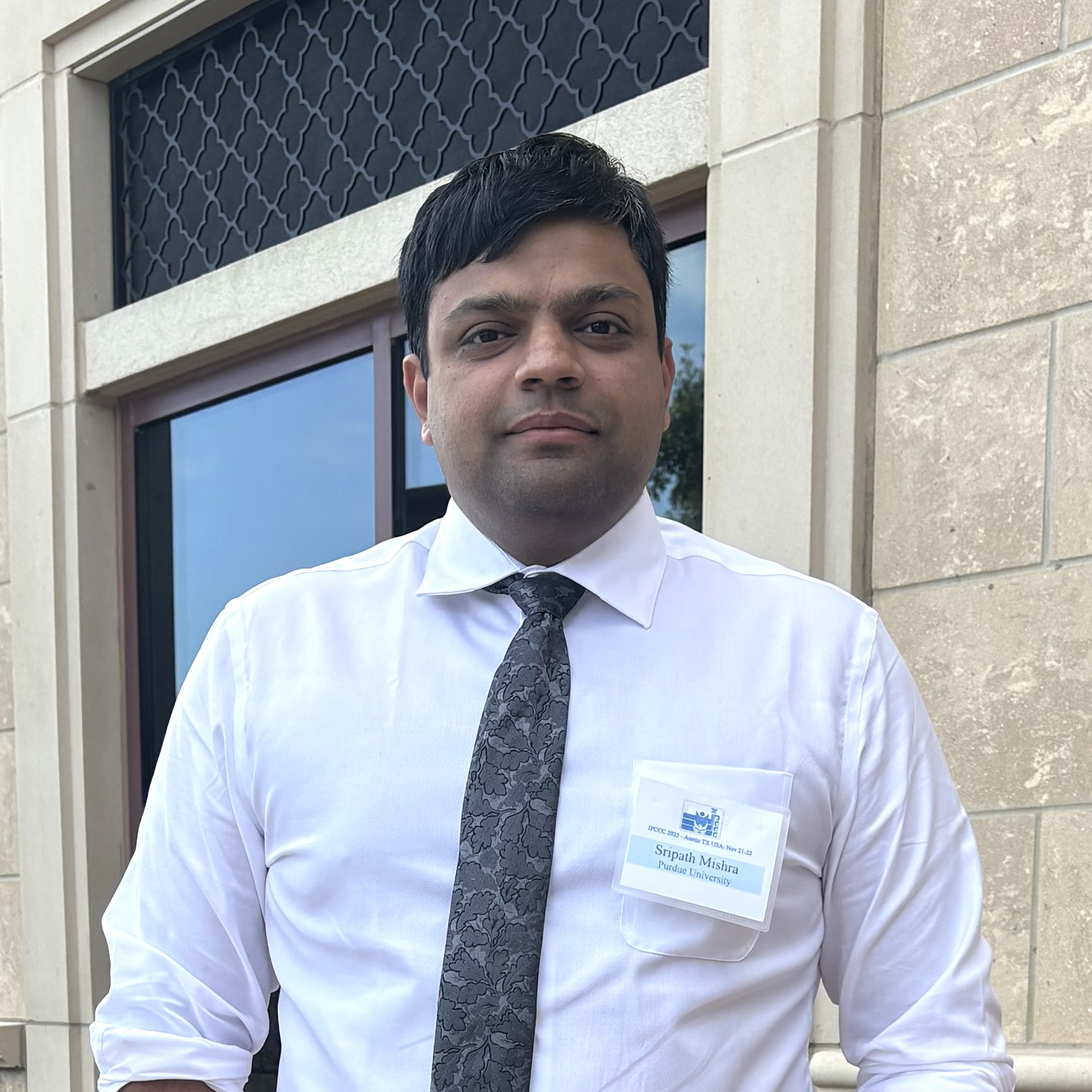
About
I build anomaly and intrusion detection systems for distributed and edge environments: detectors that hold up as traffic, topology, and threats shift, fit inside millisecond inference budgets on constrained hardware, and produce decisions an operator can actually audit. The methods I work with are federated learning, retrieval-augmented adaptation, graph neural networks, and explainable AI (XAI).
UAV swarm networks are where I stress-test all of it. Mobility-induced drift, hard compute and bandwidth budgets, and adversaries that coordinate across nodes make them the hardest deployment setting I know for detection — which is why results that survive there tend to transfer.
I am a Computer Science PhD candidate at Purdue University, defending in Spring 2027 and pursuing Applied Scientist, Machine Learning Engineer, and Research Scientist roles with a 2027 start.
Day to day: Python, PyTorch, scikit-learn, XGBoost, C++, Docker, Linux, Containernet, FPGA prototyping.
Selected work
FlowRAG — a two-stage edge–cloud detector built on the finding that on-device latency, not accuracy, is the binding constraint at the edge. An on-device screen clears roughly 90% of flows in 4.78 ms (P99 6.16 ms) on a Raspberry Pi 4B and escalates only ambiguous ones, giving +16% F1 over the strongest baseline under mobility-induced drift. IEEE EDGE 2026. Read more
UAV-CAS — a 99,492-flow digital-twin dataset spanning 1,024 configurations, calibrated against real AERPAW hardware to 0.33 Hellinger divergence — below the 0.73 ceiling that separates two independent real measurement campaigns. Benchmarking 10 IDS on it exposed a field-wide blind spot: binary detection saturates above 0.98 while stealth-paired collaborative attacks collapse to 0.51–0.86 AUROC. Dataset, simulator, and calibration data are publicly released. Dataset page
Interpretable collaborative-attack detection — recovering the set of attacks in a coordinated campaign from scenario-level labels, with decision rules auto-extracted from a surrogate tree and validated on held-out data, each mapped to a concrete operator mitigation. Under submission. Read more
Research interests
- anomaly and intrusion detection
- explainable AI (XAI) and auditable model decisions
- edge and low-latency machine learning
- federated and distributed learning
- retrieval-augmented adaptation under distribution shift
- graph neural networks
- network traffic analysis, UAV / FANET security
Research experience
Intrusion detection for UAV networks (Jan 2025 – Present) · Advisor: Dr. Bharat Bhargava
Detection for dynamic UAV swarms under real deployment constraints — on-device latency budgets, mobility-driven drift, and coordinated multi-node adversaries. Outputs include FlowRAG (IEEE EDGE 2026), the UAV-CAS dataset and benchmark, and an interpretable two-level collaborative-attack detector (under submission). See Research for the full picture.
Robust traffic classification under distribution shift (2023 – 2025) · Advisor: Dr. Sonia Fahmy
Built a testbed that isolates one network factor at a time across ten Dockerized services and five application classes, and used it to show that trace augmentation is method-specific: the same augmentation that helps packet-size-sequence classifiers measurably hurts timestamp-based ones. (IEEE IPCCC 2025.)
Near-switch network telemetry — NetEye (2022 – 2023) · NextGArchLab
Broke the accuracy–scalability tradeoff in hybrid telemetry by replaying a near-switch window through every query instead of refining a single stream, and made replay affordable with an FPGA compression pipeline. Moving monitoring logic near-switch cut data-plane update latency by more than an order of magnitude.
Graph neural networks for bug prediction (Mar 2021 – Dec 2021)
A GNN that predicts bug locations in Python GitHub projects by combining code AST structure with GitHub issue text.
Camera network analysis — CAM2 (Jan 2018 – May 2020)
Led a team building automated discovery of real-time network camera feeds from heterogeneously structured web pages: 57,364 cameras extracted from 237,257 pages, plus a feed health checker, image database, and camera-database API. (IEEE COMPSAC 2020; ACM TOIT 2021.)
Education
Ph.D. in Computer Science (in progress, expected May 2027)
Purdue University, West Lafayette, IN — Advisor: Dr. Bharat Bhargava
M.S. in Computer Science (December 2021)
University of California, Los Angeles, CA
B.S. in Computer Science (May 2020)
Purdue University, West Lafayette, IN — Honors; Dean’s Honor List; Best Sophomore Award in Computer Science
Longer version on the CV page.